Trade for you! Trade for your account!
Direct | Joint | MAM | PAMM | LAMM | POA
Forex prop firm | Asset management company | Personal large funds.
Formal starting from $500,000, test starting from $50,000.
Profits are shared by half (50%), and losses are shared by a quarter (25%).
Forex multi-account manager Z-X-N
Accepts global forex account operation, investment, and trading
Assists family office investment and autonomous management
Foreign exchange investment manager Z-X-N accepts entrusted investment and trading for global foreign exchange investment accounts.

I am Z-X-N. Since 2000, I have been running a foreign trade manufacturing factory in Guangzhou, with products sold globally. Factory website: www.gosdar.com. In 2006, due to significant losses from entrusting investment business to international banks, I embarked on a self-taught journey in investment trading. After ten years of in-depth research, I now focus on foreign exchange trading and long-term investment business in London, Switzerland, Hong Kong, and other regions.
I possess core expertise in English application and web programming. During my early years running a factory, I successfully expanded overseas business through an online marketing system. After entering the investment field, I fully utilized my programming skills to complete comprehensive testing of various indicators for the MT4 trading system. Simultaneously, I conducted in-depth research by searching the official websites of major global banks and various professional materials in the foreign exchange field. Practical experience has proven that the only technical indicators with real-world application value are moving averages and candlestick charts. Effective trading methods focus on four core patterns: breakout buying, breakout selling, pullback buying, and pullback selling.
Based on nearly twenty years of practical experience in foreign exchange investment, I have summarized three core long-term strategies: First, when there are significant interest rate differentials between currencies, I employ a carry trade strategy; second, when currency prices are at historical highs or lows, I use large positions to buy at the top or bottom; third, when facing market volatility caused by currency crises or news speculation, I follow the principle of contrarian investing and enter the market in the opposite direction, achieving significant returns through swing trading or long-term holding.
Foreign exchange investment has significant advantages, primarily because if high leverage is strictly controlled or avoided, even if there are temporary misjudgments, significant losses are usually avoided. This is because currency prices tend to revert to their intrinsic value in the long run, allowing for the gradual recovery of temporary losses, and most global currencies possess this intrinsic value-reversion attribute.
Foreign Exchange Manager | Z-X-N | Detailed Introduction.
Starting in 1993, I leveraged my English proficiency to begin my career in Guangzhou. In 2000, utilizing my core strengths in English, website building, and online marketing, I founded a manufacturing company and began cross-border export business, with products sold globally.
In 2007, based on my substantial foreign exchange holdings, I shifted my career focus to the financial investment field, officially initiating systematic learning, in-depth research, and small-scale pilot trading in foreign exchange investment. In 2008, leveraging the resource advantages of the international financial market, I conducted large-scale, high-volume foreign exchange investment and trading business through financial institutions and foreign exchange banks in the UK, Switzerland, and Hong Kong.
In 2015, based on eight years of accumulated practical experience in foreign exchange investment, I officially launched a client foreign exchange account management, investment, and trading service, with a minimum account balance of US$500,000. For cautious and conservative clients, a trial investment account service is offered to facilitate their verification of my trading capabilities. The minimum investment for this type of account is $50,000.
Service Principles: I only provide agency management, investment, and trading services for clients' trading accounts; I do not directly hold client funds. Joint trading account partnerships are preferred.
Why did foreign exchange manager Z-X-N enter the field of foreign exchange investment?
My initial foray into financial investment stemmed from an urgent need to effectively allocate and preserve the value of idle foreign exchange funds. In 2000, I founded an export manufacturing company in Guangzhou, whose main products were marketed in Europe and the United States, and the business continued to grow steadily. However, due to China's then-current annual foreign exchange settlement quota of US$50,000 for individuals and enterprises, a large amount of US dollar funds accumulated in the company's account that could not be promptly repatriated.
To revitalize these hard-earned assets, around 2006, I entrusted some funds to a well-known international bank for wealth management. Unfortunately, the investment results were far below expectations—several structured products suffered serious losses, especially product number QDII0711 (i.e., "Merrill Lynch Focus Asia Structured Investment No. 2 Wealth Management Plan"), which ultimately lost nearly 70%, becoming a key turning point for me to switch to independent investment.
In 2008, as the Chinese government further strengthened its regulation of cross-border capital flows, a large amount of export revenue became stuck in the overseas banking system, unable to be smoothly repatriated. Faced with the reality of millions of dollars being tied up in overseas accounts for an extended period, I was forced to shift from passive wealth management to active management, and began systematically engaging in long-term foreign exchange investment. My investment cycle is typically three to five years, focusing on fundamental drivers and macroeconomic trend judgments, rather than short-term high-frequency or scalping trading.
This fund pool not only includes my personal capital but also integrates the overseas assets of several partners engaged in export trade who also faced the problem of capital being tied up. Based on this, I also actively seek cooperation with external investors who have a long-term vision and matching risk appetite. It is important to note that I do not directly hold or manage client funds, but rather provide professional account management, strategy execution, and asset operation services by authorizing the operation of clients' trading accounts, committed to helping clients achieve steady wealth growth under strict risk control.
Foreign Exchange Manager Z-X-N's Diversified Investment Strategy System.
I. Currency Hedging Strategy: Focusing on substantial currency exchange transactions, with long-term stable returns as the core objective. This strategy uses currency swaps as the core operational vehicle, constructing a long-term investment portfolio to achieve continuous and stable returns.
II. Carry Trade Strategy: Targeting significant interest rate differences between different currency pairs, this strategy implements arbitrage operations to maximize returns. The core of the strategy lies in fully exploring and realizing the continuous profit potential brought by interest rate differentials by holding the underlying currency pair for the long term.
III. Long Terms Extremes-Based Positioning Strategy: Based on historical currency price fluctuation cycles, this strategy implements large-scale capital intervention to buy at the top or bottom when prices reach historical extreme ranges (highs or lows). By holding positions long-term and waiting for prices to return to a reasonable range or for a trend to unfold, excess returns can be realized.
IV. Crisis & News-Driven Contrarian Strategy: This strategy employs a contrarian investment framework to address extreme market conditions such as currency crises and excessive speculation in the foreign exchange market. It encompasses diverse operational models including contrarian trading strategies, trend following, and long-term position holding, leveraging the amplified profit window of market volatility to achieve significant differentiated returns.
Profit and Loss Plan Explanation for Forex Manager Z-X-N
I. Profit and Loss Distribution Mechanism.
1. Profit Distribution: The forex manager is entitled to 50% of the profits. This distribution ratio is a reasonable return on the manager's professional competence and market timing ability.
2. Loss Sharing: The forex manager is responsible for 25% of the losses. This clause aims to strengthen the manager's decision-making prudence, restrain aggressive trading behavior, and reduce the risk of excessive losses.
II. Fee Collection Rules.
The forex manager only charges a performance fee and does not charge additional management fees or trading commissions. Performance Fee Calculation Rules: After deducting the current period's profit from the previous period's loss, the performance fee is calculated based on the actual profit. Example: If the first period has a 5% loss and the second period has a 25% profit, then the difference between the current period's profit and the previous period's loss (25% - 5% = 20%) will be used as the calculation base, from which the forex manager will collect the performance fee.
III. Trading Objectives and Profit Determination Method.

1. Trading Objectives: The forex manager's core trading objective is to achieve a conservative return rate, adhering to the principle of prudent trading and not pursuing short-term windfall profits.
2. Profit Determination: The final profit amount is determined comprehensively based on the market fluctuations and actual trading results for the year.
Forex Manager Z-X-N provides you with professional forex investment and trading services directly!
You directly provide your investment and trading account username and password, establishing a private direct entrustment relationship. This relationship is based on mutual trust.
Service Cooperation Model Description: After you provide your account information, I will directly conduct trading operations on your behalf. Profits will be split 50/50. If losses occur, I will bear 25% of the loss. Furthermore, you can choose or negotiate other cooperation agreement terms that conform to the principle of mutual benefit; the final decision on cooperation details rests with you.
Risk Protection Warning: Under this service model, we do not hold any of your funds; we only conduct trading operations through the account you provide, thus fundamentally avoiding the risk of fund security.
Joint Investment Trading Account Cooperation Model: You provide the funds, and I am responsible for the execution of trades, achieving professional division of labor, shared risk, and shared profits.
In this cooperation, both parties jointly open a joint trading account: you, as the investor, provide the operating capital, and I, as the trading manager, am responsible for professional investment operations. This model represents a mutually beneficial cooperative relationship established between natural persons based on full trust.
Account profit and risk arrangements are as follows: For profits, I will receive 50% as performance compensation; for losses, I will bear 25% of the losses. Specific cooperation terms can be negotiated and drafted according to your needs, and the final plan respects your decision.
During the cooperation period, all funds remain in the joint account. I only execute trading instructions and do not hold or safeguard funds, thereby completely avoiding the risk of fund security. We look forward to establishing a long-term, stable, and mutually trusting professional cooperation with you through this model.
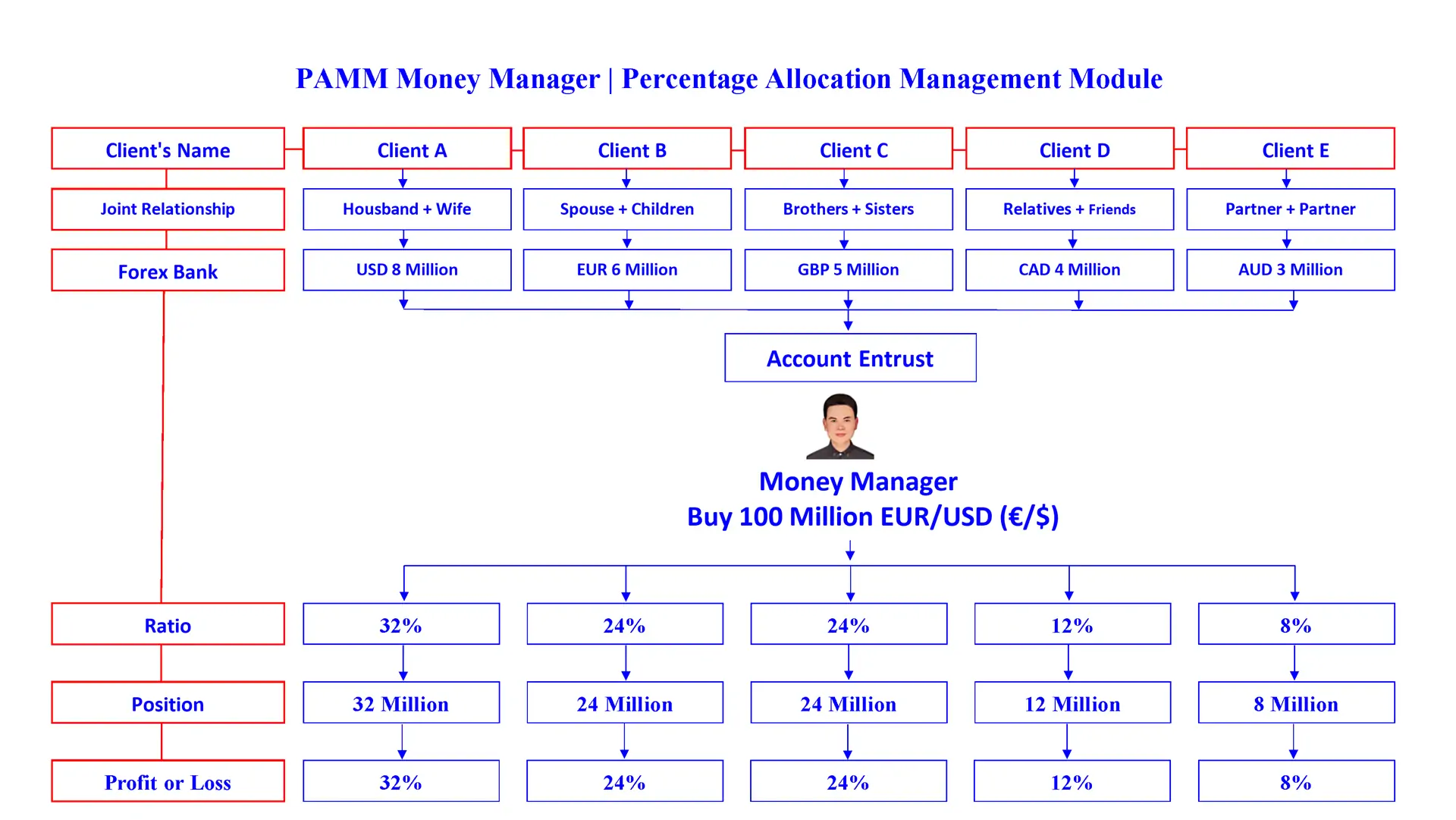
MAM, PAMM, LAMM, POA, and other account management models primarily provide professional investment and trading services for client accounts.
MAM (Multi-Account Management), PAMM (Percentage Allocation Management), LAMM (Lot Allocation Management), and POA (Power of Attorney) are all widely supported account management structures by major international forex brokers. These models allow clients to authorize professional traders to execute investment decisions on their behalf while retaining ownership of their funds. This is a mature, transparent, and regulated form of asset management.
If you entrust your account to us for investment and trading operations, the relevant cooperation terms are as follows: Profits will be split 50/50 between both parties, and this split will be included in the formal entrustment agreement issued by the forex broker. In the event of trading losses, we will bear 25% of the loss liability. This loss liability clause is beyond the scope of a standard brokerage entrustment agreement and must be clarified in a separate private cooperation agreement signed by both parties.
During this cooperation, we are only responsible for account transaction operations and will not access your account funds. This cooperation model has eliminated fund security risks from its operational mechanism.
Introduction to Account Custody Models such as MAM, PAMM, LAMM, and POA.
Clients need to entrust a forex manager to manage their trading accounts using custody models such as MAM, PAMM, LAMM, and POA. After the entrustment takes effect, the client's account will be officially included in the management system of the corresponding custody model.
Clients included in the MAM, PAMM, LAMM, and POA custody models can only log in to their account's read-only portal and have no right to execute any trading operations. The account's trading decision-making power is exercised uniformly by the entrusted forex manager.
The entrusted client has the right to terminate the account custody at any time and can withdraw their account from the MAM, PAMM, LAMM, and POA custody system managed by the forex manager. After the account withdrawal is completed, the client will regain full operational rights to their own account and can independently carry out trading-related operations.
We can undertake family fund management services through account custody models such as MAM, PAMM, LAMM, and POA.
If you intend to preserve and grow your family funds through forex investment, you must first select a trustworthy broker with compliant qualifications and open a personal trading account. After the account is opened, you can sign an agency trading agreement with us through the broker, entrusting us to conduct professional trading operations on your account; profit distribution will be automatically cleared and transferred by the trading platform system you selected.
Regarding fund security, the core logic is as follows: We only have trading operation rights for your trading account and do not directly control the account funds; at the same time, we give priority to accepting joint accounts. According to the general rules of the forex banking and brokerage industry, fund transfers are limited to the account holder and are strictly prohibited from being transferred to third parties. This rule is fundamentally different from the transfer regulations of ordinary commercial banks, ensuring fund security from a systemic perspective.
Our custody services cover all models: MAM, PAMM, LAMM, and POA. There are no restrictions on the source of custody accounts; any compliant trading platform that supports the above custody models can be seamlessly integrated for management.
Regarding the initial capital size of custody accounts, we recommend the following: Trial investment should start at no less than US$50,000; formal investment should start at no less than US$500,000.
Note: Joint accounts refer to trading accounts jointly held and owned by you and your spouse, children, relatives, etc. The core advantage of this type of account is that in the event of unforeseen circumstances, any account holder can legally and compliantly exercise their right to transfer funds, ensuring the safety and controllability of account rights.

Appendix: Over Two Decades of Practical Experience | Tens of Thousands of Original Research Articles Available for Reference.
Since shifting from foreign trade manufacturing to foreign exchange investment in 2007, I have gained a deep understanding of the operating essence of the foreign exchange market and the core logic of long-term investment through over a decade of intensive self-study, massive real-world verification, and systematic review.
Now, I am publishing tens of thousands of original research articles accumulated over more than two decades, fully presenting my decision-making logic, position management, and execution discipline under various market environments, allowing clients to objectively assess the robustness of my strategies and the consistency of long-term performance.
This knowledge base also provides a high-value learning path for beginners, helping them avoid common pitfalls, shorten trial-and-error cycles, and build rational and sustainable trading capabilities.
The forex market has entered a phase of fierce competition for existing users due to a lack of new users. Forex brokers are employing aggressive marketing models, exacerbating the infighting among forex broker platforms and creating a vicious cycle in the industry.
In the two-way trading sector of forex investment, the industry as a whole has shown a continuous decline over the past decade, and forex investment trading has gradually entered the ranks of sunset industries.
From the perspective of industry development trends, the closure of forex broker trading platforms globally will become the norm in recent years and for a considerable period to come. Behind this trend lies a profound transformation of the industry ecosystem and a continuously deteriorating market environment.
Compared to emerging industries such as digital currencies and stablecoins, which have risen rapidly in recent years, the gap in industry vitality for forex investment trading is becoming increasingly apparent. Its sunset industry characteristics are constantly being reinforced, and it has even gradually become a niche industry. The shrinking industry has directly led to an increasing scarcity of customer resources. To compete for customers in a limited market share, most forex brokerage trading platforms have turned to aggressive marketing models. Specifically, these platforms are increasing their attractiveness to customers by lowering transaction costs and compressing spreads, while simultaneously increasing rebates to expand customer acquisition channels, attempting to seize market share through these concessions. It's important to clarify that aggressive marketing models are somewhat reasonable in a rapidly growing market with a continuous increase in new users, helping platforms quickly accumulate a customer base. However, as forex trading becomes a niche industry, entering a phase of competition for existing customers with scarce new users, this aggressive marketing model further exacerbates the involution among forex brokerage platforms, leading to a vicious cycle of industry competition.
For forex brokerage platforms, the aggressive marketing model continuously squeezes their profit margins, making it difficult to support normal hedging operations by placing customer orders in the market. As a result, most platforms are forced to adopt a business model of betting against their clients. This betting model inherently involves a conflict of interest, as the platform's profits directly oppose those of its clients. If a large number of clients withdraw their profits en masse, it will put immense pressure on the platform's cash flow and could even trigger an operational crisis. Against this backdrop, some platforms may engage in illegal practices such as refusing to allow clients to withdraw funds or restricting their ability to withdraw profits, severely damaging clients' legitimate rights. Meanwhile, even some forex brokers that adopt conservative operating strategies and do not rely excessively on aggressive customer acquisition methods are choosing to scale back or even close their forex brokerage businesses due to intense market competition, in order to avoid damage to their reputation and further squeeze on their profit margins. This further confirms the current decline in the forex industry.
It is worth noting that as forex trading becomes a niche industry, the new client base entering the market exhibits differentiated characteristics. Unlike clients who blindly followed trends in the past, most new investors today have undergone systematic trading training, possess certain professional knowledge and trading experience, and their investment behavior is more rational. From a long-term perspective, well-prepared forex investors have a significantly lower probability of loss. However, if these profitable investors withdraw their funds en masse, it will further exacerbate the financial pressure on forex brokerage platforms, potentially becoming the final straw that breaks the camel's back for some platforms.
Based on the current state of the forex industry and the potential risks of platform operating models, mature forex investors, when their trading is relatively stable and their probability of profit is high, should avoid platforms with excessively low transaction costs. These platforms often have a greater risk of illegal operations due to insufficient profit margins, and may manipulate investors' profitable orders, ultimately preventing investors from withdrawing funds and harming their investment returns.
In the two-way trading market of forex investment, the trader's character has a decisive impact on investment results. Kind-hearted forex traders are often more likely to achieve stable profits in the market.
These types of traders typically possess the core qualities of non-greed and patience. These qualities help them better cope with the inherent volatility of the forex market, avoid being misled by immediate gains from short-term market fluctuations, and consistently adhere to long-term investment logic and sound trading plans, thereby gaining opportunities for sustained profitability. At the same time, forex traders with a calm and composed mindset tend to remain rational when faced with market changes and their own decision-making errors. They are willing to face and admit their mistakes, and will not stubbornly adhere to established strategies due to emotional biases. Instead, they adjust their trading strategies in a timely manner according to the actual market situation, laying the foundation for successful subsequent trading.
In contrast to kind-hearted, rational, and composed traders, cunning and greedy forex traders often fall into the trap of chasing short-term gains in the forex market. These traders lack a long-term market judgment perspective, focus excessively on immediate profits and losses, and are prone to making irrational and erroneous decisions during market fluctuations, ultimately making it difficult to achieve sustained profitability. Furthermore, while forex traders who rely on clever tricks might gain small, short-term profits through speculative methods, the forex market is inherently complex and volatile. Long-term profitability requires a sound trading system and a trustworthy investment mindset. Such highly speculative traders, lacking a core, sustainable trading logic, ultimately cannot survive in the complex forex market.
It's worth noting that attempting to gain small profits in forex trading often causes traders to miss out on better investment opportunities. These traders, overly focused on minor, localized gains, easily overlook market trends and high-quality trading targets, ultimately failing to achieve their overall profit goals. Another major negative characteristic in forex trading is impatience. Such traders often fall into the trap of frequent buying and selling when currency prices fluctuate. Frequent trading not only significantly increases transaction costs such as commissions but also leads to a chaotic trading rhythm, increasing the probability of decision-making errors and significantly reducing the likelihood of profitability. More importantly, forex traders who stubbornly refuse to admit mistakes often cling to flawed trading strategies due to wishful thinking or pride, leading to accumulated losses and ultimately extinguishing any possibility of profitability in the forex market.
In fact, the saying circulating in the forex investment field, "90% tests a trader's character, only 10% tests their investment skills," accurately reveals the core logic of market profitability. As a highly transparent trading system governed by value principles, the forex market's trajectory is not swayed by individual will. Even if some traders attempt to use so-called technical skills to conceal their character flaws and try to gain illicit profits, they ultimately cannot deceive the market. Only those with sound character, integrating rationality, patience, and integrity into the entire trading process, can achieve long-term, stable profits in the complex and volatile forex investment market.
In the context of two-way forex trading, for investors, achieving an investment return one to three times that of a fixed deposit is considered a successful investment goal.
This goal-setting logic aligns with the risk characteristics of forex trading and conforms to the core principles of rational investment, avoiding the pitfall of blind trading due to an excessive pursuit of high returns.
From actual trading practice, many forex investors have a common cognitive bias: they habitually use specific profit amounts as annual trading goals, frequently setting concrete profit indicators such as "this year's profit should be XX amount," but ultimately often fall into the predicament of year-on-year losses, and usually, the higher the profit target, the greater the actual loss. In fact, the foreign exchange trading industry possesses significant unique characteristics. Its trading environment is influenced by multiple complex factors, including the global macroeconomy, geopolitics, and exchange rate fluctuations. The uncertainty of profits is far higher than in traditional industries. Therefore, its operational goal setting logic differs fundamentally from other industries, and it is not advisable to use specific profit amounts as the core trading objective.
For participants in two-way forex trading, a more scientific and reasonable annual goal setting should focus on the core dimension of "preserving capital." When investors prioritize capital preservation, they can more clearly control trading risks, paying more attention to position management, stop-loss settings, and the execution of trading discipline during the decision-making process. This effectively avoids aggressive trading behaviors arising from pursuing short-term high profits. This capital preservation-oriented trading mindset helps investors maintain rational judgment in a complex and volatile market environment, reducing errors caused by emotional trading, and is more conducive to achieving long-term stable profits, ultimately achieving a sustainable trading state of annual profitability.
In the two-way trading scenario of forex investment, traders inevitably encounter situations where their decision-making direction contradicts market trends. At this time, the primary mindset to cultivate is to avoid falling into a state of persistent regret.
Many traders, after making a misjudgment, often fall into the trap of repeatedly looking back, constantly dwelling on hypothetical propositions like "If I had chosen the right direction, I would have profited." This excessive regret is essentially an unreasonable self-criticism. It needs to be clear that when traders make their trading decisions, they are often in a "fog" of incomplete information asymmetry and unclear market trends. The confusion and hesitation at that time are due to objectively existing cognitive limitations. Even if they returned to that decision-making point, under the same information and market conditions, they would most likely have made the same choice. Therefore, excessively criticizing one's past self is meaningless.
More importantly, traders should avoid overly romanticizing the hypothetical scenario of "choosing the right direction." Such idealized imagination not only amplifies negative emotions in the present moment but also interferes with subsequent trading decisions. In fact, throughout the entire process of forex trading, every choice a trader makes based on their own understanding, market information, and risk tolerance, regardless of whether it ultimately results in profit or loss, is the optimal solution under specific time and space conditions, and each has its own rationality and inevitability. From an investment logic perspective, market trends are constantly changing, and a trader's decisions are inherently probabilistic judgments of market trends. Profit and loss are inherent attributes of trading, and there is no need to assign excessive subjective value judgments to different outcomes.
From the perspective of trading mentality and long-term development, the human visual structure dictates that we always face forward. This physiological characteristic also applies to the cognitive orientation in forex trading—traders should always focus on future market trends and subsequent decision optimization, rather than dwelling on past regrets. Looking back excessively only consumes a lot of psychological and decision-making energy, hindering a keen awareness of market dynamics. Only by breaking free from the constraints of past decisions, accepting each transaction result with an objective and rational mindset, and focusing attention on summarizing experience and refining trading strategies can one achieve a dual improvement in mindset and trading ability in the complex environment of forex trading.
Forex traders with low expectations, low volatility, and low drawdowns have the most stable investment growth curves.
In the two-way forex market, a rather contrasting phenomenon is worth noting: traders who consistently achieve profits are often not the group with deep professional expertise or rich practical experience as commonly perceived by market participants. Instead, they are more likely to be ordinary participants who seem "completely ignorant" of the complex operating logic of the forex market. This conclusion, while seemingly counterintuitive, can be corroborated by analyzing the actual performance of various market participants. To clarify the essence of this phenomenon, we must first identify which types of traders in the forex two-way trading field actually struggle to achieve consistent profitability.
Before discussing the profitable participants in forex two-way trading, we must first exclude several groups that are excessively glorified by the market but whose actual profitability is questionable. First, we must exclude speculative capital. The legendary stories circulating in the market of speculative capital leveraging tens of thousands of dollars to generate hundreds of millions in profits are mostly fictionalized narratives. These narratives are essentially traps built on investors' get-rich-quick mentality. The higher investors' trust in these stories, the more likely they are to make irrational decisions in trading, leading to exacerbated losses. Secondly, technical analysts are not necessarily a group capable of achieving stable profits. In fact, many technical analysts' market analysis and guidance primarily serve to guide retail investors' trading direction rather than help them achieve profits. They may even mislead retail investors' trading decisions to some extent, ultimately harming their investment interests. Furthermore, traders who excessively pursue technical mastery are equally susceptible to losses and even bankruptcy. These traders often become engrossed in the intricate study of various technical indicators and trading strategies, neglecting the inherent uncertainty and randomness of the market. Over-reliance on the precision of technical analysis can lead to frequent misjudgments during market fluctuations, ultimately resulting in financial losses. In addition, champions of various live trading competitions are not necessarily representatives of sustainable profitability. Their outstanding performance during the competition is like a shooting star—briefly brilliant but unsustainable. Their trading models often rely on short-term market opportunities under specific conditions, lacking long-term replicability. Once market conditions change, they are highly susceptible to plummeting from profit peaks to losses.
Having excluded the aforementioned groups, we return to the core question: what kind of traders can achieve stable profits in two-way forex trading? The answer lies precisely with those considered "fools" by some market participants, those who are completely ignorant of the specific details of the forex market's operation. This "ignorance" manifests in their responses to specific questions about short-term markt trends and core themes—when asked about the specific direction of forex currency movements over the next few years, they don't offer subjective guesses but honestly state they don't know; when pressed about the core trading themes of the forex market over the year-end, they similarly don't offer conclusions based on speculation but clearly state they cannot predict them. However, this "ignorance" is not a genuine lack of knowledge, but rather reflects a clear understanding of market uncertainty, which is precisely the key prerequisite for their profitability. In fact, these traders don't trade blindly without a plan. Their core competency lies in constructing a logically closed-loop, risk-controlled trading system. They are able to eliminate the interference of subjective emotions and consistently and strictly adhere to the system's trading rules. This unwavering commitment to "blindly following" the rules precisely avoids the irrational actions of most traders in the market caused by over-prediction and emotional fluctuations. Thus, in the long run, they achieve sustainable profitability through the stability of their rules.
Foreign exchange investment traders should allow for losses, allow for wrong directions, and allow everything to go against their wishes.
In the two-way trading market of foreign exchange investment, mature trading cognition is the core foundation for traders to establish themselves in the market, and the key prerequisite for this mature cognition is to learn to accept various uncertain outcomes in market operation.
Specifically, foreign exchange traders first need to establish an acceptance mentality towards losses, clarify that the essence of two-way trading determines that both profit and loss are normal results of market operation, and do not need to deny their trading logic due to a single loss, nor do they have to be hesitant and paranoid about trading decisions due to fear of losses.
At the same time, traders also need to face the possibility of misjudgment in direction. The foreign exchange market is influenced by multiple repeated and complex factors such as global macroeconomic data, geopolitical changes, and monetary policy adjustments. Any direction prediction based on historical data or technical analysis may have deviations. Accepting such misjudgment is not a denial of one's own analytical ability, but a rational reverence for the complexity and randomness of the market.
It is worth noting that even for currency pairs that have been carefully researched, held for a long time, and have achieved stable profits, traders need to be mentally prepared for sudden deterioration of their fundamentals. The fundamental factors of the foreign exchange market are always in a dynamic state of change. The economic fundamentals, policy environment, and other factors that support the trend of currency pairs in the early stage may reverse due to unexpected situations. If these unexpected changes cannot be accepted, it is easy to make irrational stop loss or position decisions when the market turns, which can lead to a significant loss or even turn into a loss in the early stage.
Essentially, the maturity of forex trading is reflected in traders no longer placing their subjective expectations above the objective laws of the market, being able to accept various market outcomes that are contrary to their expectations, and abandoning the paranoid perception that market trends must conform to their own expectations. This means that traders need to have a clear understanding that the direction of the foreign exchange market has its own objectivity and independence, and will not change due to individual subjective will. Any attempt to force the market to operate in the direction they desire is a irrational mentality that goes against the essence of the market.
Only when foreign exchange traders truly allow all possible outcomes to occur, without fear of losses and judgment errors, nor are they entangled in sudden reversals of profitable positions, and respond to various market fluctuations and changes with an inclusive and rational attitude, can they get rid of the interference of subjective emotions on trading decisions and gradually establish a stable and sustainable trading system. This is also the core indicator of whether a foreign exchange trader is moving towards maturity.
The various myths of sudden wealth circulating in the foreign exchange margin market are almost all carefully edited narrative products in the upstream of the interest chain.
In the two-way foreign exchange trading market, the widely circulated "myth of sudden wealth" among investors is essentially a false narrative. These myths are not real products under the objective laws of the market, but marketing tools carefully packaged and created by market stakeholders. Their core purpose is to attract a large number of inexperienced novice investors to enter the market, deliver continuous traffic and funds to the market, and meet the potential demands of stakeholders.
From the actual market situation, the vast majority of so-called 'instant wealth myths' do not have authenticity. According to market observations, the proportion of such false narratives is as high as 99%, all of which are artificially constructed false scenes. It is not difficult to deeply analyze its formation logic, and it can be found that sudden wealth itself is the core aspiration of many novice investors when entering the foreign exchange market. Some profit seeking speculative forces in the market precisely grasp this common psychological demand and package and interpret the "sudden wealth scene" through similar film and television script creation methods. This is consistent with the creative logic of some current brainless films and TV dramas, such as "ordinary individuals are taken care of by wealthy women to achieve class crossing" and "domineering CEOs fall in love with ordinary Cinderella". The reason why these unrealistic plots can be widely spread is that they satisfy some people's fantasy of achieving success without effort. However, if the plot is created according to the real human logic of "high wealth and handsome men and white wealth and beautiful women are of equal status" in reality, it is often difficult to attract the audience's attention; The myth of sudden wealth in the foreign exchange market is no exception. It is precisely because every novice investor harbors a desire for quick wealth that such false narratives have the soil to survive and spread.
In the field of two-way foreign exchange trading, the negative impact of such false wealth myths far exceeds their surface effect of "attracting traffic". In addition to inducing a large number of traders who are not fully prepared, lack professional knowledge and risk awareness to enter the market rashly, becoming the "fuel" in market fluctuations, and ultimately facing a high probability of capital losses, what is more serious is their destructive impact on the market ecology and investor mentality - it greatly disrupts the original intention of the vast majority of investors who hope to steadily accumulate wealth through steady trading. In fact, for the vast majority of foreign exchange investors, as long as they can abandon the speculative mentality of overnight wealth and adhere to the principle of rational investment, they have the ability and opportunity to gradually accumulate wealth; From the perspective of actual profit potential, if investors can establish conservative return expectations, not pursue unrealistic high returns, and only aim for "returns that are twice, twice, or even three times higher than fixed deposits", it is not difficult to achieve an annualized profit of more than 10%. This profit target is easily achievable for investors with basic trading skills and risk control awareness.
In the two-way trading market of foreign exchange, introverted traders often possess a more natural advantage compared to extroverted traders.
The core source of this advantage lies in the inherent nature of the foreign exchange trading industry - seeking inward.
Unlike other industries that require frequent external communication and rely on the integration of external resources, the core logic of foreign exchange trading lies in the precise control of one's inner state and deep perception of true thoughts. The quality of a trader's decision-making does not depend on the accumulation of external information, but rather on the clarity of self-awareness and stable control of inner emotions. This industry characteristic naturally aligns with the personality traits of introverted traders.
One of the core traits of introverted traders lies in their adaptation to and enjoyment of solitude, which perfectly aligns with the core requirement of "looking inward" in forex trading. In the trading process, whether it's analyzing market trends, formulating trading strategies, or managing emotions during position holding, traders need to invest sufficient time and energy in independent thinking, deeply combing their own trading logic, identifying potential cognitive biases, and simultaneously perceiving inner emotional fluctuations to avoid negative emotions such as greed and fear from interfering with decision-making. Introverted traders are able to maintain focus in a solitary environment, completing self-examination and reflection without external interference. This ability enables them to be more proactive in exploring their inner states and calibrating their trading mindset, and it is also easier for them to form a stable trading rhythm and a mature decision-making system through long-term trading practice.
Compared to introverted traders, the personality traits of extroverted traders exhibit a certain degree of mismatch with the "inward-seeking" essence of foreign exchange trading. Extroverted traders have strong social attributes and often need to invest a lot of time and energy in external social interactions. This outward allocation of energy makes it difficult for them to set aside sufficient time for self-examination and inner perception. When exposed to high-frequency social interactions for a long time, extroverted traders' attention is more easily drawn by external information, making it difficult for them to settle down and sort out their own trading logic and inner state, thus hindering their ability to deeply explore self-awareness and precisely control emotions. This difference in energy allocation leads to extroverted traders often needing to put in more effort to achieve awakening and transformation in trading cognition, and it is also more difficult for them to quickly form a stable trading mindset. From industry practice, most foreign exchange trading experts who truly possess a mature trading system tend to have the trait of reducing ineffective social interactions and focusing on self-improvement, which also indirectly confirms the adaptability of foreign exchange trading to introverted traits and the natural advantages of introverted traders in this field.
Core Cognitive Deficiencies and Obstacles for Forex Traders: Excessive Concern for Self-Reliance and Excessive Desire for Profit.
In the forex market, the core issue preventing most traders from achieving long-term, stable profits often boils down to two fatal cognitive flaws and obstacles: an obsession with "self-reliance" and a biased goal of "profit-seeking." These two problems are intertwined, jointly restricting traders' rational decision-making and execution capabilities, becoming key barriers on the path to profitability.
The obsession with "self-reliance" manifests specifically as an excessive pursuit of "self-correction" throughout the trading process, and a subconscious tendency to seek validation. In the market analysis and trend prediction stages of forex trading, traders often fall into the trap of "proving themselves," directly linking the correctness of their market judgments to their personal abilities and cognitive levels. The most typical behavioral manifestation of this cognitive bias in trading execution is "holding onto losing positions"—when the direction of the position contradicts the actual market movement, the trader does not make a stop-loss decision based on objective market signals, but rather chooses to hold onto the incorrect position out of a "reluctance to deny oneself." Essentially, this kind of "holding onto losing positions" behavior is not a rational judgment of market trends, but a blind defense of personal opinions. Its core aim is to avoid the embarrassment of "self-contradiction," while ignoring the potential risks of two-way fluctuations in the forex market. Ultimately, it often leads to small losses escalating into significant financial losses.
The biased goal of "being too greedy for money" stems from a misperception of the trader's profit objective—treating "making money" as the sole core goal of trading, even equating money with the ultimate pursuit in life. Undeniably, profit is one of the core objectives of forex trading, but traders need to understand that trading is not the only way to acquire wealth. Employment, business operations, and many other methods can all lead to wealth accumulation. This misperception directly causes serious utilitarian biases in trading: on the one hand, the eagerness to profit can lead to irrational behaviors such as frequent trading and over-leveraging, causing traders to ignore market rules and risk control, falling into a vicious cycle of "chasing highs and selling lows"; on the other hand, viewing money as the purpose of life can cause excessive emotional fluctuations when facing profit volatility—greed and recklessness when profitable, and fear and anxiety when losing, further exacerbating decision-making errors. In fact, money in foreign exchange investment and even in life as a whole should be defined as a tool to achieve goals, rather than the goals themselves. The lack of understanding of this core logic is a major reason why many traders fall into trading difficulties.
Forex traders are more like miniature CEOs and decision-makers.
In the two-way forex market, a successful forex investor's role goes far beyond that of a mere trade executor; it's more akin to the CEO and BOSS of a miniature business unit.
The core logic of this role is that forex trading is not simply speculative buying and selling, but a systematic business activity requiring coordinated market analysis, risk management, and self-awareness improvement. Every trading decision is like a strategic deployment in business operations, directly impacting capital security and profit generation.
From a core task perspective, successful forex traders need to simultaneously advance two key tasks, which complement each other and form the foundation for profitable trading. First, it's about focusing on trend discovery and opportunity capture in the market, the core of which lies in accurately identifying breakout signals and trend directions of major currency pairs. Essentially, the profit potential in the forex market stems from the price fluctuations and trend extensions of currency pairs. A market lacking volatility makes it difficult to form effective price spreads, and failing to grasp the trend direction leads to trading decisions that deviate from market rules, ultimately resulting in losses. Therefore, traders need to rely on diverse tools such as macroeconomic data, geopolitical dynamics, and technical indicator analysis to continuously track the supply and demand changes and market sentiment of major currencies, thereby identifying trading opportunities with profit potential.
Secondly, it involves cultivating and improving one's internal cognitive abilities. Competition in the forex market ultimately boils down to competition in traders' cognitive levels. The objectivity of market fluctuations and the bias in traders' subjective judgments are often the key factors leading to trading errors. The core goal of internal cultivation is to continuously improve one's trading cognitive system, including a deep understanding of market operating rules, a clear definition of the applicable boundaries of trading strategies, an accurate understanding of one's own risk tolerance, and the scientific management of trading psychology. Only by continuously iterating one's trading cognition can one maintain rational judgment in a complex and ever-changing market environment, avoid being disturbed by short-term market noise, and effectively cope with various uncertainties and risks in the trading process.
It is worth emphasizing that when forex traders can solidly complete the two core tasks of market opportunity discovery and internal cognitive cultivation, and achieve their organic synergy, they can build a sustainable profit model. The foreign exchange market has a huge amount of capital and is constantly volatile. As long as you always adhere to scientific trading logic, respond to market changes with a mature cognitive system, and accurately capture trend opportunities, you can continuously obtain reasonable returns under the premise of compliance. This is the core logic behind the long-term profit potential of the foreign exchange market.
In the realm of two-way forex trading, trading itself can be seen as both the most difficult and the easiest thing. This seemingly contradictory perception is actually closely related to the trader's level of commitment and depth of understanding.
Nothing in the world is inherently inherently difficult or easy; the key lies in whether one takes action. Proactive practice can gradually transform even the most challenging tasks into easier ones; hesitation and reluctance to try will make even the simplest things increasingly difficult. This logic also applies to cognitive improvement and the learning process—with a spirit of inquiry and proactive exploration, even the most profound knowledge can be gradually mastered; without initiative in learning, even basic common sense will become obscure and daunting.
This principle is particularly evident in the two-way forex trading scenario. For traders, if they can immerse themselves in in-depth study, systematically organize and comprehensively master the knowledge system, industry common sense, practical experience, and technical methods of forex trading, and thoroughly research the core elements and potential risks of trading, the originally complex trading logic and operational procedures will naturally become clear, and trading decisions will be made with greater confidence and basis. Before mastering the core logic and operational essence of forex trading, most traders often compare it to traditional economic activities like opening a physical store, operating a factory, or running a foreign trade company, or even to simply working for someone else. At this point, they generally feel that forex trading is far more difficult than these areas, even considering it the most difficult thing in the world.
However, as traders continuously learn and practice, truly understand the inherent laws of forex trading, accurately grasp the core logic of market fluctuations, skillfully utilize various analytical tools and trading strategies, and develop a mature and stable trading system, their perception of the difficulty of trading undergoes a fundamental shift. They then discover that forex trading is simpler and easier than traditional economic activities that involve high fixed costs and complex supply chain and market channel issues, and even more flexible and relaxed than working for someone else, which is limited by fixed hours and location and has limited income growth potential. This leads to the perception that "forex trading is the easiest thing in the world." This shift in perception is not essentially a change in the inherent difficulty of trading itself, but rather a significant improvement in the trader's own capabilities and cognitive dimensions, enabling them to proactively control and mitigate the difficulties of trading.
In the forex two-way trading market, the core reason successful traders achieve excess profits lies in their long-term accumulated trading experience and advanced cognitive level, rather than the absolute advantage of the technical indicators they use.
Compared to the choice of tools, the trader's own depth of understanding, perspective, and mindset are the key variables determining trading results. This core logic is particularly evident in the forex two-way trading scenario. Specifically, the profit logic of seasoned traders who can consistently generate profits does not rely on the superiority or inferiority of a single technical means or specific indicator tool (such as the common analytical tools like moving averages), but rather stems from a profound understanding of market patterns, precise risk control, and a clear understanding of their own trading behavior. Essentially, it is a concentrated manifestation of comprehensive human qualities in trading, rather than a result of simply being empowered by tools.
In stark contrast to successful traders, ordinary forex traders generally face profitability difficulties. The core problem lies precisely in cognitive biases—most ordinary traders invest a great deal of energy in learning trading techniques, excessively pursuing the application skills of various indicators, while neglecting the accumulation of trading experience and the improvement of cognitive abilities. This learning model, which emphasizes tools over understanding, makes it difficult for traders to cope with the complex challenges of the two-way fluctuations in the foreign exchange market. They often find themselves passive in market changes and struggle to achieve stable profits.
It is important to clarify that accumulating trading experience and improving cognitive levels are not achieved overnight; they require long-term investment and systematic training. In this process, traders first master basic trading techniques, then gain extensive practical experience, transforming fragmented technical knowledge into reusable trading experience. Through continuous review and reflection, they elevate their experience to a deeper understanding. This gradual evolution from technique to experience, and then to understanding, is the essential path for traders to break through profit bottlenecks and achieve trading success. Any attempt to skip the stages of experience accumulation and cognitive improvement, relying solely on technical tools for profitability, will ultimately be unsustainable.
In the two-way trading scenario of foreign exchange investment, traders' large profits and huge losses often occur silently, a characteristic that contrasts sharply with traditional investment fields.
Compared to foreign exchange investment, the operating model of traditional fund investment is more transparent and marketing-oriented. Fund managers typically actively promote themselves and their products through various channels, regularly disclosing or selectively revealing performance data. Their core objective is to attract investors to subscribe to fund products; after all, in a normal market environment, fund products lacking proactive marketing struggle to gain sufficient market attention and capital inflows.
From an industry perspective, foreign exchange investment falls under the category of off-exchange trading, exhibiting a niche and unpopular nature. More importantly, central banks worldwide, driven by the core objectives of maintaining the stability of their financial systems and ensuring the competitiveness of foreign trade exports, generally employ strict regulatory and control measures in the foreign exchange market, further exacerbating the information isolation inherent in the foreign exchange industry. Against this backdrop, large holders of funds in the foreign exchange market rarely engage in frequent public disclosure. Only in special circumstances involving short-term market manipulation do coordinated actions by related parties occur. Looking back at market practices over the past two decades, there have indeed been several cases where large foreign exchange holders manipulated the market through joint meetings and negotiations, but such situations are not the norm in the industry.
In summary, foreign exchange investment and trading are inherently a highly secretive industry. The entire trading process is largely a psychological game and decision-making contest among traders relying on market data presented on computer terminals. Whether a trader achieves substantial profits through accurate judgment or suffers huge losses due to market fluctuations or poor decision-making, as long as the corresponding broker does not proactively disclose relevant trading information, these profits or losses often remain unknown to the outside world. This further confirms the core characteristic of foreign exchange investment and trading: its quiet and unassuming nature.
In the field of two-way trading in foreign exchange investment, this industry has shown significant characteristics of a sunset industry and belongs to the niche industry category with limited market capacity.
From the actual performance of market capacity, although the foreign exchange market is nominally large, in recent decades, the monetary policies of most central banks around the world have been anchored to the US dollar interest rate. This universal policy orientation has directly led to a significant compression of the interest rate spread between different currencies, and has remained in a relatively narrow range for a long time. As one of the core sources of profit in foreign exchange trading, the limited space of interest rate differentials directly limits the profit margin of mainstream currency pair trading, resulting in the profit level of related transactions being firmly locked in a lower range, making it difficult to achieve substantial breakthroughs.
Due to the rigid constraints of profit margins, the development prospects of the foreign exchange industry have a clear ceiling, and the overall growth potential of the industry is extremely limited. This situation also directly affects the development pattern of institutions in the industry. Most of the top ranked foreign exchange industry giants internationally have already attached themselves to large investment banking systems, either being acquired by large investment banks or becoming their controlling subsidiaries. From the strategic layout of large investment banks, the inclusion of foreign exchange brokers is not based on profit as the core goal, but rather as an important component of brand strategy layout, leveraging the business layout in the foreign exchange field to enhance the comprehensiveness and influence of their own brand. The core reason is that the capacity of the foreign exchange market itself is limited, making it difficult to support large-scale profits. Currently, this field no longer has traffic dividends, and the potential user base is relatively small with clear growth limits. The foreign exchange market has more often become a tool for promoting large investment bank brands rather than a core profit sector.
Based on an objective assessment of the current situation in the aforementioned industry, we solemnly warn newcomers in the foreign exchange investment field that if there are still other career paths to choose from, they should try to avoid entering the foreign exchange investment trading field as much as possible, as it is an industry that combines sunset attributes and niche characteristics. It should be clarified that as an investor with experience in large capital operations, this withdrawal is not due to concerns about others sharing benefits due to the superior market prospects, but based on a profound understanding of the nature of the industry. In fact, before entering the foreign exchange market, I already had a reserve of millions of dollars in funds, which did not come from foreign exchange trading, but were accumulated through investing in foreign trade factories. Due to China's foreign exchange control policies, my large offshore funds cannot enter the country directly. Entering the foreign exchange market is only to find a feasible investment channel for this portion of funds, rather than because the field has outstanding profit advantages.
Finally, it should be emphasized that there is a fundamental cognitive premise in the field of foreign exchange investment trading: although a stable annual return of 10% -20% may be achieved through scientific trading strategies, there is almost no possibility of doubling or multiplying funds in this field, let alone achieving the goal of overnight wealth. For any group interested in investing in foreign exchange, a clear understanding is the core prerequisite for avoiding irrational investment decisions and viewing industry value rationally.
In the forex market, emotional stability is arguably one of the core competitive advantages for traders. Compared to other trading factors, irrational emotions often have a more direct and devastating negative impact on trading decisions.
The forex market's inherent two-way volatility and instant feedback make traders' emotions more susceptible to market fluctuations. Loss of emotional control often leads to the collapse of trading logic, resulting in irreversible losses.
From the perspective of general interpersonal communication, ordinary people are more receptive to calm and rational communication and criticism in everyday situations. Even with differing opinions, a calm emotional tone ensures the smooth transmission of information. Conversely, even if the other party's viewpoint is fully reasonable and feasible, a poor communication tone can easily trigger resistance. This tendency to prioritize emotions over facts is amplified in the forex trading context, producing even more severe negative consequences. While emotional resistance in daily communication may only affect interpersonal relationships, emotional dominance in trading directly distorts the judgment of market signals and disrupts established trading strategies.
In actual forex trading, negative examples of emotionally driven decision-making are extremely common. When the market clearly shows signs of directional divergence—meaning existing trading positions fundamentally conflict with the overall market trend—some traders, driven by wishful thinking, resentment, and other negative emotions, choose to hold onto losing positions, ignoring the core fact that the market trend has substantially reversed. This ultimately leads to a continuous expansion of losses. The essence of this behavior is that traders prioritize personal emotions over objective market laws, replacing rational judgment of actual market movements with subjective assumptions.
More significantly, many forex traders fall into the cognitive trap of "prioritizing personal feelings," focusing excessively on their current losses and subjective pain, while actively ignoring core objective factors such as market trends, policy changes, and the logic behind exchange rate fluctuations. This cognitive bias creates a vicious cycle: losses trigger negative emotions, which further hinder rational understanding of market facts, leading to more irrational decisions such as averaging down or cutting losses, ultimately exacerbating the losses.
Ultimately, success in two-way forex trading is essentially a process of rationality overcoming emotion. For traders, only by actively eliminating the interference of subjective emotions and establishing a decision-making logic centered on market facts, consistently using objective factors such as market trends, data signals, and risk thresholds as the sole basis for trading decisions, can they build a stable trading system in the complex and ever-changing forex market and gradually achieve long-term trading success. Emotional management does not negate the trader's subjective feelings, but rather guides them rationally, allowing objective facts to dominate trading decisions. This is also one of the key dimensions that distinguishes professional traders from ordinary traders in two-way forex trading.
Forex traders must proactively absorb new knowledge to avoid being left behind.
In the two-way trading scenario of forex investment, the development of a trader's core competencies relies on continuously pushing beyond their comfort zone and proactively embracing new ideas. Only by keeping pace with the times and actively adapting to changes in the market environment can one effectively avoid the risk of being eliminated by industry iterations.
This core requirement is not unique to the forex investment field but is a universal law permeating individual growth and social development. It has already shown distinct characteristics in traditional social life. Those with forward-thinking intelligence consistently maintain an awareness of pushing beyond their comfort zone, actively trying new things in unknown areas. Conversely, some who cling to their established ways remain confined within their comfort zone, habitually rejecting new attempts with negative attitudes such as "I won't do this" or "I can't do that." It is worth noting that the rapid iteration of the times is constantly reconstructing cognitive systems and survival rules. Many concepts and survival logics formed by our parents based on past experience have gradually lost their applicability in today's diversified and fast-paced era. Similarly, the cognitive framework and thinking patterns established by our generation today will likely lag behind the next generation in the next two or three decades due to further development of the times.
Returning to the essence of two-way forex trading, the market environment faced by traders is constantly changing, and industry development continuously presents new demands. This requires traders to continuously learn and break through their own cognitive boundaries, proactively mastering new things and logics that can adapt to market changes. Looking at the industry's development history, the market environment has never stopped iterating. For example, the negative interest rate policies and quantitative easing measures that emerged globally in the past decade were novel phenomena that broke through traditional financial understanding, profoundly impacting the pricing logic and trading rhythm of the global forex market. In the current stage of development, the rise of emerging financial forms such as digital currencies and stablecoins has had a significant impact on the forex investment and trading field. This impact has not only changed the traditional forex trading market ecosystem but has also further shrunk the already niche forex trading industry, leading to a decline in market activity. Against this backdrop, forex traders need to establish dynamically adjustable investment strategies and rationally plan their capital size based on the actual market capacity. Compared to blindly expanding capital investment, moderately reducing the capital size is more in line with the current market situation, because the current forex investment market no longer has the capacity to accommodate large-scale funds. Excessive expansion of capital size will inevitably amplify trading risks. This requires traders to always maintain a keen insight into the development of the situation and continuously optimize and adjust their investment pace according to changes in the market environment to ensure that their trading strategies are effectively adapted to the development trends of the times and the actual market conditions.
Forex traders with self-awareness are more likely to successfully transition from beginner to expert.
In the two-way trading scenario of forex investment, traders with self-awareness tend to be more adept at this transition. This phenomenon stems from a clear understanding of the boundaries of their own knowledge, a cognitive trait that also exhibits significant differentiation across broader social contexts.
Specifically, those with rational cognitive abilities, even those with established expertise in their familiar areas, will humbly accept their lack of knowledge when venturing into unfamiliar territory. Conversely, those lacking rational cognitive ability are prone to falling into a "cognitive blind spot," often overgeneralizing their abilities. Even when faced with completely unfamiliar or unexplored areas, they may underestimate the cognitive threshold based on subjective assumptions of "cleverness," assuming they can quickly master the subject with their existing skills, ignoring the professional barriers and core logical differences between different fields.
This cognitive difference is further amplified in the two-way forex trading field, directly impacting a trader's growth trajectory and trading results. Forex traders with self-awareness, when entering a trading niche they are completely unfamiliar with, they can readily accept their own lack of knowledge and even proactively face the initial "cognitive awkwardness"—they clearly understand that in unfamiliar trading scenarios, they are highly likely to make frequent mistakes due to unfamiliarity with market rules, trading logic, risk control, and other basic common sense. Because of this clear understanding of their own shortcomings, such traders will proactively establish a systematic learning mindset, continuously supplementing their knowledge gaps through multiple paths such as studying professional trading books, searching authoritative industry materials, and consulting with experienced traders, constantly iterating their trading knowledge and practical skills, ultimately achieving a steady improvement in trading ability.
Conversely, forex traders lacking self-awareness often fall into the trap of "cognitive arrogance" when facing unfamiliar forex trading. They are unable to face their own cognitive shortcomings, nor do they develop a sense of awareness of their own deficiencies. Instead, they approach trading with a subjective bias of "omniscience." In this mindset, they neither proactively seek guidance from industry veterans nor are willing to invest the effort to fill knowledge gaps. They consistently rely on rigid cognitive logic to navigate the complex and ever-changing foreign exchange market, making it difficult to iterate and upgrade their trading skills. The foreign exchange market itself is characterized by high volatility and high professionalism, demanding a deep understanding and extensive practical experience from traders. Traders lacking self-awareness and a willingness to learn often end up with trading losses due to their inability to accurately manage market risks and respond to market changes, and may even be forced to leave the forex trading field altogether.
In the two-way forex market, wealth accumulation always follows a gradual logic; there is no path to instant riches.
For forex traders, the core prerequisite for stable profits is to acknowledge the growth cycle of trading skills and build their trading system with a long-term perspective, rather than hoping for short-term, accidental gains.
Looking at the development patterns of various industries, top practitioners all require time to hone their skills. This pattern also applies to the highly specialized field of forex trading. The generally accepted growth cycle in the industry shows that the first three years are a beginner's period, focused on familiarizing oneself with the rules and accumulating basic knowledge; three to five years are a growth period of in-depth exploration, requiring continuous trial and error in practice to calibrate direction; five to eight years gradually lead to a mature stage of skilled operation, forming a relatively stable execution logic; only after ten years of dedicated practice, undergoing the complete test of market cycles, can one be considered an expert with professional judgment and the core ability to independently cope with complex market changes.
However, many forex trading novices fall into a cognitive bias, the core problem being that they ignore this objective growth pattern. In the cognitive framework of these traders, the improvement of forex trading skills lacks a clear time anchor. They often disregard the industry consensus of "ten years of honing a sword," mistakenly believing that core profitability can be mastered without long-term accumulation.
Specifically, the cognitive misconceptions of novices are mainly reflected in three aspects: First, they overestimate their own ability boundaries, naively simplifying the development of trading skills into a short-term learning process, even hoping to achieve basic financial freedom through a few months of theoretical study and practical operation, completely ignoring the common rule that top levels in various industries require decades of in-depth cultivation; Second, they confuse the boundary between accidental gains and core competencies, attributing short-term profits in trading to their own operational skills and judgment, failing to clearly recognize that such gains may only be accidental coincidences in market fluctuations or the result of short-term luck, lacking sustainability; Third, they lack respect for the complexity of the market, failing to realize that the forex market is affected by multiple factors such as macroeconomics and geopolitics, and its uncertainty requires traders to rely on long-term accumulated experience and knowledge, rather than short-term subjective judgments.
Talent is either driven by interest and proactive cultivation, or a tenacious pursuit forced by adversity.
In the two-way trading field of forex investment, few traders are born with "talent." Its core either stems from a heartfelt passion or is rooted in the tempering of real-world challenges.
In traditional understanding, people often equate exceptional ability in a particular field with talent. However, a deeper examination reveals that any professional competence beyond the ordinary does not come from nowhere, but is the result of decades of consistent accumulation—a comprehensive ability condensed from the refinement of behavioral habits, the honing of personality traits, and the optimization of reaction mechanisms. It is also the inevitable product of focusing on a single area with unwavering dedication, thoroughly exploring its principles and achieving a profound understanding.
The core difference between people lies in the dimension and depth of their actions: some remain at the superficial level of "taking action," some achieve synergy between "thinking and planning" and "taking action," while true masters reach the realm of "deep cultivation with heart." Compared to those who merely think, the results of an hour of dedicated study by someone who focuses on their mind are comparable to ten hours of superficial effort by the latter; compared to mechanical execution by hand, an hour of in-depth study is worth more than a hundred hours of aimless labor by the latter. The root of this difference lies in whether one is willing to immerse themselves in understanding the essence and exploring the underlying principles.
Returning to the field of forex investment, the logic of a trader's "talent" is similar. Firstly, it stems from an extreme passion and desire for exploration: a deep interest in the inherent logic of trading mechanisms, a proactive approach to understanding core principles, and a gradual development of a unique cognitive system through exploration. Secondly, it arises from the pressure and tempering of real-world difficulties: having experienced the hardship of financial scarcity and the pain of humiliation caused by lack of money, a strong determination to cultivate trading skills and accumulate wealth is born. Even after countless trading setbacks and market trials, they maintained unwavering resilience, focusing intently on mastering the essence of trading. Ultimately, they broke through cognitive barriers, mastered trading logic, and achieved a leap in wealth accumulation.
Finally, "talent" in forex trading is never an innate gift, but rather the inevitable result of proactive cultivation driven by interest, or the relentless pursuit forced by adversity.
The path to mastering forex two-way trading is essentially a progressive process for traders, moving from confusion to clarity, from complexity to understanding, and from stagnation to smooth operation.
This progressive logic is consistent with the growth patterns in human society—from birth, individuals embark on a journey of development from initial exploration to skillful mastery, from struggle to ease and success. After initial chaotic trials, they gradually clarify their understanding, accumulate experience, and ultimately enter a stable and smooth path.
For practitioners of forex two-way trading, the cognitive difficulties encountered upon entering the market are common. The forex trading system encompasses multiple dimensions, including professional knowledge, market common sense, technical analysis, practical experience, and investment psychology. The unknown nature of this new field is like a fog, easily leading beginners into a predicament of "the more they learn, the more confused they become; the more they delve, the more bewildered they feel." At this stage, knowledge accumulation is often fragmented, technical application lacks systematic support, interpretation of market fluctuations remains superficial, and investment mentality is easily swayed by short-term gains and losses, making it difficult to form a stable trading logic.
The key to breaking through the current impasse lies in the systematic reconstruction of accumulated diverse elements. When traders actively initiate the process of organizing, summarizing, classifying, filtering, and refining knowledge, scattered knowledge points gradually connect into lines and weave into a dense network. The application scenarios and boundaries of technical tools become increasingly clear, lessons learned from successes and failures in practical experience are transformed into replicable decision-making bases, and the understanding of investment psychology is grounded in practical methods of mindset regulation. In this process, the operating rules of the market and the inherent logic of market fluctuations gradually emerge, dispelling previous confusion and uncertainty.
When traders have thoroughly mastered and understood all dimensions of the trading system, they will reach a turning point of "sudden enlightenment." At this point, complex technical analysis can be condensed into concise decision signals, complex market information can be quickly filtered out to identify core elements, investment mentality becomes more calm and stable, trading actions become natural and fluid, and the profit logic is steadily established. This transformation from "difficult" to "simple" to "smooth" relies on the trader's respect for difficulties rather than fear, and their dedication to in-depth study rather than complacency. Only by maintaining a persistent passion for learning and a meticulous attitude towards research, and by continuously refining our understanding and optimizing our systems through market practice, can we overcome the thorns of growth and reach the smooth path to advanced trading.
Large investors prioritize steady growth and gradual accumulation. Retail investors, on the other hand, are driven by short-term gains and prone to reckless bets.
In the two-way trading ecosystem of the forex market, the vast difference in capital size directly shapes the drastically different investment logics and behavioral paradigms of institutional investors (large investors) and retail investors.
Retail investors often harbor speculative aspirations of "high returns with low investment, overnight riches," while institutions adhere to the investment principle of "high leverage with low returns, accumulating small gains into significant profits." This divergence in philosophies not only determines the orientation of trading strategies but also profoundly influences the ultimate outcome of investments.
From a core perspective, the goals set by institutions and retail investors are strikingly different. For institutions with substantial capital reserves, "high leverage with low returns" is not a sign of conservatism or weakness, but a rational choice based on capital size and risk tolerance. With their massive capital, institutional trading decisions prioritize long-term stability and sustainability, rather than drastic short-term fluctuations in returns. In the investment framework of these entities, an annual return of 20%-30% is considered satisfactory. This seemingly modest return reflects a deep respect for market dynamics and an extreme consideration for capital security. The goal is to achieve steady asset appreciation through the accumulation of small, consistent profits.
In contrast, retail investors, with their relatively small capital, often prioritize "leveraging small amounts for large gains." They frequently hope to leverage limited funds to generate excess returns, hoping to achieve rapid wealth growth through the two-way fluctuations of the foreign exchange market, even harboring dreams of multiplying their capital several times over. This pursuit inherently carries a strong speculative element, making retail investors more prone to short-sighted profit-seeking in their trading decisions, thus sowing the seeds for future risks.
This difference in philosophy extends to the implementation of risk control strategies. Their trading behaviors are like two completely different boxing styles, vividly illustrating the core difference between "first ensure invincibility, then wait for the enemy's vulnerability" and "eagerness for victory, neglecting defense." Institutional investors always prioritize risk control in trading; their core logic is "protect yourself first, then seek profit." This strategy is like a boxer's agile footwork in a match, constantly adjusting their posture through leaps and bounds to avoid fatal attacks. Even when minor impacts occur, solid defensive skills minimize damage, fundamentally safeguarding the bottom line of capital security.
Individual investors, on the other hand, often act in the opposite way. Their eagerness for quick profits leads them to prioritize offense over defense in trading. In pursuit of maximizing returns, they frequently employ aggressive strategies such as full-position or heavily leveraged trading, much like a boxer throwing a powerful punch at the start, attempting to quickly overwhelm their opponent, completely neglecting to build their resilience. This strategy, while seemingly proactive, actually exposes them to extremely high risk. If the market moves against their expectations, they are easily caught off guard and become passive.
This significant difference in risk tolerance ultimately leads to their different experiences during market fluctuations. Individual investors' investment vision is often limited to short-term gains, lacking judgment on long-term market trends and contingency plans for adverse market conditions, making them inherently less resilient. When the market experiences minor adverse fluctuations, retail investors, due to limited capital reserves and excessive leverage (fully leveraged positions are essentially a hidden manifestation of high leverage), often find it difficult to withstand market shocks, frequently resulting in margin calls.
In contrast, cases of institutional investors experiencing margin calls are extremely rare. On one hand, their substantial capital reserves provide a significant safety buffer; even during periodic market corrections, their sheer size allows them to withstand volatility and greatly reduce the probability of margin calls. On the other hand, their scientific risk control systems and diversified investment strategies further mitigate the risk exposure of any single trade, enabling them to maintain a stable position in complex market environments. This is the core guarantee for institutions to achieve long-term profitability.
Choose a reputable forex brokerage platform with a strong track record, long operating history, and minimal reliance on marketing.
In two-way forex trading, the choice of brokerage platform directly impacts a trader's fund security and trading experience, making it a crucial initial step in the investment decision-making process.
For forex traders, prioritizing reputable brokerage platforms with a strong track record is a core principle for mitigating trading risks. These platforms have undergone long-term market testing and typically have established robust risk control systems and mature operating mechanisms. They offer greater assurance in terms of fund repayment capabilities, trading system stability, and compliance services, providing traders with a more reliable trading environment.
Traders should avoid brokerage platforms with excessive marketing during the selection process. From an industry perspective, platforms that rely heavily on marketing often reflect a lack of core competitiveness. High-quality, normally operating platforms attract customers through word-of-mouth and service quality, while platforms that rely on constant marketing hype may be compensating for weaknesses in their core capabilities through publicity, often lacking effective support for service stability and fund security.
It's worth noting that weak financial resources are a typical characteristic of these unregulated platforms, and excessive marketing is a direct outward manifestation of their insufficient strength. To seize market share, these platforms often employ aggressive tactics such as exaggerated advertising and sensational marketing to attract customers. Behind this behavior lies a lack of confidence in their own operational capabilities and a failure to sustain long-term development with their core strengths. Choosing such platforms will bring significant potential risks to forex trading.
In the forex market, both long and short positions can be opened independently, making one person a "profit unit."
This "one-person company" setup places the trader at the forefront of value creation: decision-making, risk control, and profit/loss are all self-managed.
Traditional success is often simplified to "gaining both fame and fortune." However, many high-earning professionals, despite their substantial bank accounts, are merely pawns in a larger game; once they leave the platform, the applause stops abruptly, and their prestige instantly diminishes. Their wealth curve and self-esteem curve are not synchronized, resulting in the paradox of "paper wealth, inner poverty."
Forex traders are different: they are the legislators and executors of strategies; they are the guardians and valuers of funds; every profit requires no external approval, and the account balance is a real-time vote of "social recognition." This "mini-CEO" identity ensures that success is not secondhand applause, but firsthand achievement.
When profits are realized, the sense of accomplishment at that moment isn't the delayed gratification of a "company bonus," but rather the immediate confirmation of "I am the source of value"—the battlefield is in front, the spoils are in hand, and self and wealth grow in tandem. This is the ultimate romance unique to independent traders, something that cannot be outsourced.
The Independent Value and Success Perception of Investors in Forex Two-Way Trading.
In the context of forex two-way trading, traders participate in market competition and achieve wealth appreciation as independent entities. This process of achieving profit goals through their own decisions and abilities transcends mere wealth acquisition, embodying a deeper meaning of success in realizing one's life value.
Looking back at the traditional societal understanding of success, the secular framework often binds it to the pursuit of fame and fortune. Here, "fame" primarily refers to the respect of others and social recognition, constituting a crucial dimension of the secular evaluation system of success. Even individuals who have already entered the ranks of "success" by secular standards will find it difficult to find true inner peace and satisfaction if they fail to gain the recognition and respect of others.
This cognitive dilemma is particularly pronounced among wealth owners: some groups, despite accumulating considerable wealth, struggle to establish a clear sense of success. The root cause lies in the fact that such wealth acquisition often relies on a dependent role—either serving as top managers in large corporations or profiting as professional managers leveraging platform resources. This non-independent wealth accumulation model fails to earn deep respect from society and leaves individuals lacking a sense of accomplishment from autonomously creating value, ultimately failing to grasp the core essence of success.
In general, true success possesses a dual core: firstly, the ability to autonomously control one's life trajectory and achieve predetermined goals through personal ability; secondly, the direct acquisition of wealth in the process of creating value, simultaneously gaining widespread social recognition. These two aspects complement each other, constructing a solid and profound understanding of success.
The unique nature of two-way forex trading provides a practical vehicle for this true success. In this scenario, traders participate in the market as independent investors, their role comparable to the helmsman of a micro-enterprise—directly leading trading decisions and driving wealth generation and accumulation without relying on any platform or entity. This path to success is highly direct and intuitive: traders are always at the forefront of wealth creation, every decision is directly linked to profit, and every gain stems from their own judgment and execution. This immersive experience of wealth creation gives success a unique quality, and the resulting sense of accomplishment is not an externally bestowed byproduct, but rather originates from an inner affirmation of value, ultimately settling into a solid and lasting sense of achievement satisfaction.
Capital size plays a decisive role, followed by psychological qualities and lastly, technical skills. With sufficient capital, earning $10,000 from $1 million is easy; with sufficient trading skills, earning $1 million from $10,000 is virtually impossible.
In the two-way trading system of the forex market, a trader's capital size is a key variable influencing trading strategy formulation, psychological control, and ultimate profit. Its importance permeates the entire trading process, far exceeding many superficial trading factors.
Forex traders with large capital reserves have a wider range of strategic options. Compared to small-capital traders' urgent pursuit of short-term gains, large-capital traders are not burdened by the psychological constraint of "quickly accumulating wealth," resulting in a more stable and composed mindset. This stable mindset is further reflected in risk control, eliminating the need for frequent stop-loss orders and better avoiding irrational operations caused by short-term fluctuations. Based on this, large-capital traders can calmly deploy medium- to long-term trades, using time to digest short-term market fluctuations and capture more stable trend-based profit opportunities.
From the operational patterns of the forex market, trending markets have relatively short durations, while consolidation and range-bound markets dominate. Under these market characteristics, long-term carry trade strategies often become the core path for practicing long-term value investing in the forex market. Compared to the application of trading techniques, the scale of capital plays a decisive role in such long-term layouts—sufficient capital reserves can support traders in resisting the pressure of capital occupation during consolidation periods, allowing them to calmly wait for the continuous accumulation of carry trade profits. Technical optimization can only play a supporting role and cannot replace the fundamental supporting value of capital scale.
It is worth noting that the argument in the market that "small-capital traders can achieve financial freedom by overcoming capital limitations through technical skills" often lacks realistic support. From the perspective of actual trading scenarios, small capital inherently suffers from weak risk resistance, limited strategy selection, and insufficient capital turnover flexibility. Even with mature trading techniques, it is difficult to withstand the impact of sudden market fluctuations, let alone achieve a leap in wealth through continuous trading. In fact, for small-capital traders to expect to achieve financial freedom with limited funds, not only do they face extremely high operational difficulties, but from the perspective of market operation logic and the laws of capital appreciation, its feasibility is extremely low, and can even be regarded as an unrealistic fantasy.
The Dilemmas and Conflicts of Growth for Young Forex Traders.
In the field of two-way forex trading, young people often face a more demanding working environment. The nature of this field means it doesn't favor younger individuals. In the core logic of forex trading, capital size remains decisive, while the trader's psychological qualities serve as important support, albeit secondary. Together, they form the key foundation for trading success.
It's worth noting that both effective capital accumulation and the cultivation of a mature psychological mindset require time and experience; they cannot be achieved overnight. For most traders, it's typically around forty years old that they gradually accumulate enough capital to support effective trading, while simultaneously developing a calm, rational, and composed trading mindset. These are precisely the core weaknesses that young people often struggle to overcome in the short term.
In essence, forex trading is a comprehensive form of self-cultivation for practitioners. It requires traders to continuously refine various dimensions of their mindset through long-term practice, achieving profound iterations in self-awareness and behavioral patterns. The survival rules in this field are particularly brutal. Traders may not need exceptionally outstanding strengths, but they absolutely cannot have any significant weaknesses. Any flaw in mindset or ability can become a fatal reason for being eliminated by the market.
Human nature's inherent bad habits such as greed, impatience, and wishful thinking are amplified infinitely under the leverage effect of forex trading. Overcoming these deep-rooted flaws often requires a decade or even longer of dedicated refinement, gradually smoothing out the rough edges and impatience in one's character. More importantly, in the forex market, initial accidental successes are often highly deceptive, mostly the result of chance market conditions, not a reflection of the trader's mature ability and mindset. Such short-lived successes often fail to hold onto hard-earned wealth and may instead breed arrogance and recklessness due to premature "victory," sowing the seeds for subsequent trading failures.
The Value and Investment Principles of Moving Averages in Forex Trading.
In the complex market environment of forex trading, the invaluable worth of moving averages deserves in-depth exploration and attention from every trader. In today's deluge of online information, various trading indicators abound, some boasting accurate predictions, others touting short-term profits, attracting countless traders. Yet, the seemingly simple moving average indicator is severely underestimated amidst this clamor, even becoming an object of neglect by most market participants. In fact, the logic behind using moving averages is not complicated, especially suitable for long-term investment strategies. Simply grasp the core trend: hold long positions in an uptrend and rationally place short positions in a downtrend. This aligns with the core principles of long-term value investing, anchoring the basic direction of market movement in a simple and effective way.
For forex traders, moving averages represent not only a trading tool, but also a set of investment principles and rhythm control logic that have been tested by the market over a long period. As long as you consistently adhere to the core principles of moving average investing and trade in accordance with the market rhythm it guides, achieving profitability in the forex market is not an unattainable goal. However, it's crucial to understand that long-term investing is never a smooth road. Over a holding period of several years, numerous challenges are inevitable. The most agonizing period for traders is undoubtedly the holding phase accompanied by fluctuating losses. During this process, account fluctuations will continuously test the trader's psychological defenses. Every reversal in market movements can trigger anxiety and wavering. This discomfort and torment are precisely the psychological hurdles that long-term investing must overcome, and the ultimate test of a trader's determination to uphold the principles of moving average investing.
Profit Mindset and Trading Success/Failure in Forex Two-Way Trading.
In the two-way trading ecosystem of the forex market, the difference in profit mindset is often the core factor determining a trader's success or failure. Participants who adhere to a fixed-income mindset are highly unlikely to achieve long-term success in this highly volatile and risky market. The essence of forex trading is a dynamic game of risk and return. This game naturally divides two different types of profit-makers: forex brokers, with their fixed mechanisms such as commissions and spreads, become fixed-income earners in the market, while forex traders must face market volatility head-on, pursuing returns while bearing risk—they are typical risk-reward traders.
If traders are trapped in a fixed-income mindset, equating forex trading with a daily wage or part-time job, fixated on the certainty of daily and monthly income, and taking the immediate feedback of funds arriving as their core source of psychological comfort, then this fixed mindset will inevitably become an obstacle to trading success. Guided by this mindset, traders are prone to two extremes: either becoming overly conservative in their pursuit of stable returns, hesitant to seize excellent trading opportunities and missing profit windows; or becoming aggressive in their pursuit of daily or monthly fixed return targets, blindly entering the market without sufficient analysis, ignoring market risk boundaries, and ultimately suffering financial losses due to irrational operations.
Conversely, when traders develop a risk-return mindset aligned with the nature of the forex market, examining trading from the perspective of an entrepreneur or business owner, possessing a long-term profit-seeking mentality and risk tolerance, they can break free from the constraints of short-term profit fluctuations and accept market uncertainty and floating losses with a more composed attitude. This mindset gives traders a longer-term perspective and a more stable mindset, preventing anxiety and panic in the face of market fluctuations. Instead, they can maintain rational judgment, accurately grasp market trends, patiently wait for excellent trading opportunities under controllable risk, and thus achieve more robust trading decisions and long-term profit goals.
High leverage does not equate to a high win rate, and the ability to close positions at any time does not guarantee profits.
In the two-way trading system of forex investment, every trader needs to deeply understand the core differences and respective advantages and disadvantages between intraday trading and long-term investment. This is the fundamental premise for building a sound trading logic and avoiding systemic risks. So-called intraday forex trading essentially falls under the category of short-term trading. From the underlying logic and natural laws of financial market operation, this trading model focusing on short-term fluctuations is not sustainable. If used as a long-term trading strategy, traders will find it difficult to achieve the goal of stable profits.
As one of the world's largest financial markets, the forex market always follows its own unique operating rhythm and cyclical patterns. The formation, initiation, and development of market trends often require a specific time dimension to support them. Not every trading day can form a trend with trading value. Attempting to profit through intraday trading in a market environment lacking effective market support violates the objective laws of market development.
From the core logic of profitable trading, profit generation always depends on the space created by market price fluctuations. The expansion of this space inevitably relies on time. Without sufficient time support, the space for price fluctuations is naturally greatly limited. Intraday trading requires traders to complete all entry and exit operations within the same day. This excessively compressed time frame often leads traders to chase after short-term, minute fluctuations, making it difficult to grasp the core market trend and easily resulting in unnecessary transaction costs and psychological damage due to frequent trading. Ultimately, it degenerates into ineffective operations lacking logical support, making it difficult to achieve sustained profit breakthroughs.
In the complex ecosystem of forex trading, professional growth requires a decade, while achieving true mastery and monetization may only take a year.
The growth of a trader in forex trading is never a smooth, overnight process. Accumulating experience often requires a long period of time, perhaps up to ten years.
These ten years are essentially a process of building a comprehensive professional competency system. From the fundamental theories and industry knowledge of the forex market to the refinement of practical trading techniques and strategies, and even to the essential qualities in deeper areas such as investment psychology and risk management logic, all these require repeated verification and gradual consolidation through repeated trading practice.
Every judgment of market fluctuations, every execution of a trading order, and every review of profit and loss results are concrete manifestations of accumulated experience. Only through such long-term, meticulous cultivation can the foundational framework supporting subsequent trading be built.
In stark contrast to the long period of accumulation in the early stages, once traders have completed their foundational work and achieved a breakthrough and enlightenment at the cognitive level under a certain opportunity, the sublimation of experience and the leap in ability often only take a year or even less.
This enlightenment is not a chance flash of inspiration, but the inevitable explosion after long-term accumulation. At this point, traders can integrate previously scattered knowledge, techniques, and experience, break down cognitive barriers, and form a systematic trading logic and judgment system.
With this clear understanding, they can accurately perceive the core laws of market operation, keenly capture those hidden high-quality investment opportunities, find the rhythm and grasp the pulse in complex two-way trading, and achieve the leap from stable profits to substantial gains. This process of sublimation from quantitative change to qualitative change often allows the accumulation of ten years of experience to be realized in a short period of time as tangible investment results.
The road to forex trading is always fraught with difficulties. The perseverance of "ten years of honing a sword" is not only an essential path to accumulating ability, but also a dual test of the trader's patience and insight.
Not everyone who embarks on this path reaches the end. Many traders either succumb to the tedium and hardship of the long accumulation period and choose to leave halfway; or they lack core trading insights, failing to break through cognitive bottlenecks and transform from novice to seasoned trader, ultimately missing out on success.
Essentially, achieving goals in the forex trading field depends not only on personal effort and perseverance but also on the arrangement of fate and opportunity. Different traders' life trajectories and opportunities converge here, and those who ultimately become mature and successful traders often encounter a moment of enlightenment during their long-term perseverance.
The arrival of this opportunity requires both thorough prior preparation and the occasional favor of fate, becoming a true reflection of the collision of different life circumstances and opportunities in the forex trading field.
The Difference in Return Logic Between Two-Way Foreign Exchange Trading and Bank Wealth Management.
In two-way foreign exchange trading, one of the core metrics for evaluating the success of a trader's strategy is whether its returns surpass those of time deposits in bank wealth management products. For foreign exchange investors adopting a conservative strategy, achieving two to three times the return of a bank time deposit is considered a successful milestone.
This difference in returns is closely related to the operational logic of bank wealth management funds. After absorbing social funds, banks primarily invest in areas such as debt lending and stock investment. However, their operational logic is always based on conservatism—to avoid potential risks, banks often proactively forgo some investment opportunities with potential. This risk-averse orientation directly lowers the overall return level. A deeper reason lies in the extremely large amount of funds managed by banks. This massive scale dictates that they must prioritize stable returns. Any aggressive operations could trigger systemic risks; therefore, the principle of prioritizing stability permeates the entire process of bank investment operations.
It's worth noting that the size of the capital profoundly influences the investment strategy choices of accounts of different sizes, a logic particularly evident in the forex investment field. For large accounts, the larger the capital, the stronger the demand for stability. Their operational logic is comparable to large-scale military operations, requiring strict adherence to trading discipline and the avoidance of flashy and risky operations. A well-structured and rigorous strategy is essential to ensure capital safety and steady growth. Conversely, small accounts in forex investment are more flexible. Their core strategy lies in achieving unexpected gains, much like a small unit conducting special operations. They can seek excess returns through precise timing and flexible operating models. This difference in strategy is essentially a natural choice resulting from the matching of capital size and risk tolerance.
Delayed Gratification and Investment Logic in Forex Two-Way Trading.
In the investment scenario of forex two-way trading, the selection and implementation of long-term investment strategies is essentially a concrete manifestation of the trader's delayed gratification psychology. The value of this psychological trait can actually be found in broader life experiences.
In traditional life contexts, the lack of immediate results for something does not equate to a flawed direction; the realization of value for many things often involves a long period. Just as the effort of spring sowing in agriculture may not yield a harvest in late spring or summer, but more often requires the passage of seasons to accumulate, reaping the rewards in autumn or even further into the future, this principle of "asynchronous effort and reward" also profoundly applies to the field of foreign exchange investment.
Specifically, a clear divergence in investment behavior exists in the two-way foreign exchange market. A significant number of traders favor short-term trading models, their core demand being the pursuit of immediate feedback. They crave to validate the correctness of their judgments through a closed loop of "today's effort, immediate return." This obsession with short-term gains is essentially a projection of the psychology of instant gratification into investment decisions.
In contrast, another group of traders exhibits a strong tendency towards delayed gratification. They actively choose long-term investment paths, even willing to maintain holding periods of three to five years. In the minds of these traders, investment returns are never an instantaneous linear correspondence. Current profits may stem from past planning and investment, while the value of the time, effort, and capital invested now may require a three- to five-year period to materialize.
From a more fundamental investment perspective, truly stable and successful trading in the forex market often relies on the support of delayed gratification psychology. This restraint against short-term temptations and adherence to long-term value are the core prerequisites for long-term investment to navigate market fluctuations and realize profits.
The Core of Courage and the Value of Breaking Through Cognition in Two-Way Forex Trading.
In the realm of two-way forex trading, consistently maintaining unwavering investment courage is one of the core qualities of a trader navigating market fluctuations. The value of this quality can perhaps be examined from a broader perspective of social cognition, thereby clarifying its deeper logic and practical significance.
In traditional social contexts, "bragging" often carries a negative connotation. Most boastful individuals lack genuine ability and factual support, and such empty talk is essentially a deceptive and opportunistic act. However, it's worth noting that a rare breed of exceptional "braggarts" exist. Their pronouncements are not baseless but rooted in keen insight into future trends and bold visions of innovative paths. These seemingly groundbreaking expressions are actually the embodiment of genius, harboring the seeds of unconventional innovation. From the other extreme, those who never engage in such "bold talk" often find themselves trapped in mediocrity. The root cause lies in a deep-seated lack of self-confidence that erodes their courage to imagine boldly, confining them within established frameworks and preventing them from exploring broader possibilities.
Looking back at the growth trajectories of many successful individuals, it's easy to see that those seemingly naive "bragging" moments of childhood were actually the embryonic form of their life dreams, becoming a lasting driving force that propelled them forward. It is this driving force, fueled by the belief in "fulfilling promises," that compels them to continuously improve and relentlessly climb the ladder of success over the years, ultimately overcoming numerous obstacles and transforming their former boasts into tangible life achievements, turning "bragging" into a beacon illuminating their path to dreams.
From a macro perspective of social development, every advancement in human civilization is inseparable from bold ideas that break with convention and transcend current understanding—even if these ideas were considered "bragging" at the time. It is this kind of thinking and exploration that dares to push the boundaries of cognition that injects continuous vitality into social progress, driving the iteration of cognitive systems and the innovation of productivity.
Returning to the two-way trading scenario of forex investment, this spirit of breaking through cognition and upholding beliefs must ultimately be grounded in the practical experience of traders. For forex traders, mere momentary courage is far from sufficient; they must cultivate an indomitable spirit and a relentless drive for progress. Only in this way can they stand firm amidst the market's ups and downs and achieve long-term success. In the journey of forex trading, any discouragement or retreat can be the final straw that breaks the camel's back. Once faith collapses, it's easy to fall into the trap of giving up, ultimately missing out on long-term investment value.
The qualities of a trader in forex two-way trading: "Learning from all things" teaches you reverence, while "questioning everything" grants you freedom.
In the complex ecosystem of forex two-way trading, a trader's cognitive framework and behavioral principles directly affect the stability of investment logic and the sustainability of practical results. Crucially, this involves maintaining a core attitude of learning from all things while exercising prudent skepticism. The foreign exchange market is volatile, reflecting multiple external variables such as macroeconomic cycles, geopolitical games, and industry policy adjustments, while also being guided by micro-signals like market sentiment fluctuations and unusual capital flows. Therefore, traders need an open-minded perspective to observe the market, treating various market phenomena, industry experience, and even cross-disciplinary insights as valuable resources to refine their understanding of market patterns through observation and summarization. However, the inherent uncertainty of the market means that any understanding has limitations. This requires traders to maintain a skeptical spirit, not be bound by preconceived notions, and not equate local experience with universal laws, critically examining every market signal and conclusion.
At its core, this skepticism is the construction and adherence to an independent thinking system. In the forex trading field, various authoritative opinions, industry interpretations, and so-called "expert experience" abound, but blindly believing them can easily lead to cognitive biases and turning one into a passive follower of market fluctuations. Truly mature traders inevitably reject blind obedience to authority and do not treat others' opinions as gospel. Instead, they build an independent cognitive system based on their deep understanding of the market, characterized by logical consistency and clear responsibilities. This system allows them to rationally discern the reasonable elements and applicable boundaries of authoritative viewpoints, and to use their own analytical framework to filter, verify, and integrate information. Every trading decision stems from their own independent judgment, rather than a simple replication of external opinions.
While upholding independent thinking, traders must also abandon the irrational mentality of gambling-style investing and establish a trading principle centered on self-reflection, with external advice as a supplement. The essence of forex trading is grasping market patterns and managing risk effectively, not reckless speculation. This requires traders to always use their own investment system as the core support for decision-making, placing the advice of others as supplementary reference. One can say that their own proven investment logic, risk control standards, and decision-making processes are like the main ingredients in cooking, determining the core flavor and underlying logic of the trading strategy; while the advice of others is like a secondary ingredient, providing supplementary perspectives in specific scenarios, but not the key element guiding the decision. Only by clearly defining the primary and secondary relationship between self-awareness and external advice can traders maintain clarity amidst the complexities of market information, avoid being misled by various distractions, and achieve rational, controllable, and long-term stable trading behavior.
In the complex market environment of two-way forex trading, traders must not treat textbook theories as gospel, much less use them as the sole basis for trading decisions.
The fluctuations in the forex market are influenced by a combination of variables, including the global macroeconomy, geopolitics, and market sentiment. The complexity of its dynamic changes far exceeds the presupposed boundaries of theoretical models. Most trading methods described in textbooks are often limited to idealized theoretical assumptions, lacking a comprehensive consideration of the real market environment, and thus becoming nothing more than unrealistic theoretical deductions.
A closer examination reveals that these textbook-style trading methods are mostly subjective concepts based on static assumptions, many even stemming from arbitrary, guesswork designs detached from market practice. They lack both long-term market validation and empirical support for consistent profitability in real-world trading scenarios. If traders blindly copy these methods, they not only fail to capture effective trading opportunities but are also highly susceptible to trading difficulties due to the disconnect between theory and practice.
In contrast to blindly following theoretical dogma, the essence of forex two-way trading demands that traders develop an independent cognitive system and critical thinking skills. Based on a full understanding of market complexity, traders must abandon reliance on ready-made methods and gradually explore and refine trading methods that suit their own trading habits, risk tolerance, and cognitive dimensions. Furthermore, what truly enables traders to thrive in the volatile forex market is a unique and exclusive investment and trading system—not simply a collection of trading strategies, but a complete system integrating market understanding, risk control, decision-making logic, and execution discipline. Only by relying on such a personalized system can traders seize the initiative in the game of two-way trading and achieve rational and sustainable trading behavior.
For investors with limited capital, attempting to replicate the strategies of investment gurus will only backfire.
In the two-way trading market of forex, traders often unconsciously turn to various highly regarded investment methods while exploring profit paths. However, rationally scrutinizing the strategies of so-called investment gurus has become a crucial prerequisite for mitigating trading risks and accurately identifying one's own strengths and weaknesses.
From the perspective of the global investment market ecosystem, numerous investment gurus are hailed as paragons, and their investment philosophies and operational methods are often regarded as gospel. However, deeper analysis reveals that when these investment gurus actively or passively disclose their positions, their behavior essentially deviates from the realm of pure market trading, even implying suspicion of cheating and market manipulation. The core logic behind this lies in the fact that a master investor's market influence can trigger a chain reaction, with countless followers blindly building positions based on their published holdings. This large-scale capital flow guided by a single entity is essentially the same as the stock market manipulation tactics of large investors who use their financial advantage to dominate market trends. Ultimately, this disrupts the market's original equilibrium and distorts the normal price formation mechanism.
For small and medium-sized investors with limited capital, it is even more crucial to clearly recognize the core differences between themselves and investment masters. The mainstream investment methods employed by these masters, such as value investing, are often built upon their substantial financial reserves, comprehensive information channels, and professional investment research teams—resources that small and medium-sized investors often lack. Without sufficient capital, it is impossible to support the core elements of value investing, such as long-term holding, diversified portfolios, and risk hedging, and it is also difficult to achieve the capital allocation and return balance logic behind the masters' strategies. Therefore, if one ignores the limitations of one's own financial strength and resource endowment and blindly copies the operation path of masters, not only will it be difficult to replicate their profit results, but it is also very easy to fall into a passive operation due to the mismatch between strategy and one's own conditions, and ultimately end up with a counterproductive and unprofitable trading outcome.
Psychological Game and Balancing in Forex Trading.
A Chinese proverb says, "A son doesn't grow up until his father dies." Its core meaning is that when the protection of the parents exists, the younger generation often struggles to truly shoulder responsibility. Only when that protection disappears and the burden inevitably falls on their shoulders are the younger generation forced to mature, achieving mental maturity and transformation in a short period. However, everything in the world has two sides. Behind this proverb lies another concern—those who are forced to shoulder heavy responsibilities from a young age and "forced to mature" under pressure often experience persistent anxiety throughout their lives. This premature growth comes at the cost of a lifetime of psychological burden.
This simple wisdom also applies to the two-way trading scenario of forex investment. In the forex trading market, the urgency to profit is often the core driving force behind traders' in-depth study. Without a strong pursuit of profit targets, many traders find it difficult to focus on understanding market patterns, refining trading strategies, and accumulating practical experience, thus hindering their ability to build core competitiveness in a complex and ever-changing market environment. However, everything in excess is harmful. If traders are overly consumed by the anxiety of profit and fall into the trap of "overexertion," they easily become trapped in a state of constant psychological tension. This not only makes it difficult to make rational trading decisions but also makes even a good night's sleep a luxury, turning trading itself into a form of mental and physical torture.
Therefore, in forex investment trading, managing one's psychological relationship with trading and accurately adjusting one's psychological rhythm is a core issue that runs throughout a trading career. The essence of trading is grasping market patterns and controlling one's own mindset. If psychological balance cannot be achieved, and anxiety is allowed to persist and even accompany one throughout life, even if profits are achieved in trading, it may ultimately damage physical and mental health. It is important to understand that the ultimate purpose of investment and trading is to empower life, not to sacrifice quality of life and physical and mental health. If you lose your physical and mental health and the ability to perceive happiness, no amount of profit will ever have any value.
Investment Dilemmas and Cognitive Biases of Retail Investors in Two-Way Forex Trading.
In the two-way forex market ecosystem, the main participants are individual investors, commonly known as retail investors. Compared to institutional investors with their financial strength and professional team support, retail investors are often in a weak and vulnerable position, which easily breeds anxiety and a sense of urgency.
In order to seek better investment returns in the volatile forex market, many retail investors actively cut back on daily living expenses, focusing all their capital accumulation on the investment market, resulting in a rather frugal lifestyle. The popular saying, "Making dot-to-do repairs in life, spending money like water in investments," aptly depicts the reality of this group of retail investors.
Cognitively, almost every investor understands the core logic that "people should not be slaves to money; money should serve human life." However, under the lure of profits and the pressure of risks in the forex market, this rational understanding often fails to translate into action, and most retail investors remain unconsciously trapped in a passive situation driven by money.
In the realm of two-way foreign exchange trading, for Chinese citizens, prudently avoiding such investments is a more prudent choice.
From the perspective of industry characteristics and market environment, two-way foreign exchange trading generally features high leverage and low entry barriers. These characteristics easily attract investors harboring fantasies of "getting rich quick," often ignoring the multiple risks lurking beneath and the true state of the industry's development. Currently, the foreign exchange investment industry has gradually entered a downward cycle, becoming a niche and unpopular investment area, not a worthwhile investment opportunity. More importantly, the pricing logic of most major global currencies is pegged to the US dollar, resulting in persistently low interest rate differentials between different currencies and extremely narrow exchange rate fluctuation ranges. This directly determines that the profit margin in foreign exchange trading is inherently very limited, making it extremely difficult for ordinary investors to profit. The expectation of "making big money" is ultimately just an illusion.
For Chinese citizens, the most critical weakness in participating in foreign exchange investment lies in the lack of legality, which directly leads to a chain of compounded risks. Due to compliance requirements, top global forex brokers generally refuse to accept Chinese citizens as their primary clients. This reality has inadvertently pushed the forex investment needs of Chinese citizens to smaller forex platforms worldwide. Some of these smaller platforms, however, prey on the information asymmetry between Chinese citizens' investment needs and compliance requirements, becoming unscrupulous entities specifically targeting and harming Chinese investors. Various forms of fraud, misappropriation of funds, and malicious slippage are commonplace, infringing upon investors' rights.
In summary, Chinese citizens participating in forex investment not only face the challenges of an industry downturn and meager profits, but also bear the risk of platform fraud due to a lack of legitimacy. This investment choice itself contradicts the global trend towards compliance and standardization in the financial market. Therefore, for Chinese citizens, avoiding forex trading altogether is undoubtedly the optimal choice based on a rational balance of risk and return.
Short-term, small-capital forex trading is not worthwhile, but long-term, large-capital forex investment is.
In the two-way trading field of forex investment, different capital sizes and trading periods often correspond to drastically different investment values and return prospects. Short-term, small-capital forex trading lacks practical investment value, while long-term, large-capital forex positioning has a core logic worth participating in.
Looking back at the global financial market landscape over the past two decades, the interest rate systems of major economies' central banks have become deeply tied to the US dollar interest rate. This correlation has directly reshaped the volatility logic of the forex market—the core difference in value between currencies has focused on interest rate levels. The existence and volatility of interest rate differentials directly determine the fluctuation range of currency pair prices. When interest rate differentials approach zero, currency pair prices struggle to form an effective fluctuation range, and price movements tend to be flat. At this time, any trading based on short-term price fluctuations is unlikely to yield substantial profits. Against this backdrop, short-term forex trading essentially functions more as a supplementary source of market liquidity. Small-capital investors participating in short-term trading are essentially miniature liquidity providers; their trading activities inject short-term liquidity into the market rather than generating sustainable profits. Limited by factors such as transaction costs and insufficient volatility, these short-term traders often struggle to avoid the gradual depletion of their capital, ultimately leading to their exit from the market.
In contrast to the passive situation of small-capital short-term trading, from the perspective of large-capital investors, long-term positioning in the forex market still possesses clear investment value. In particular, the interest accumulation model centered on carry trades is a rare and stable profit growth point in the forex investment field, a profit logic often overlooked by most market participants. The core value of carry trades lies in leveraging interest rate differentials between different currencies, continuously accumulating interest income by holding high-interest currencies and selling low-interest currencies over the long term. This profit model is unaffected by drastic short-term price fluctuations and possesses strong stability. It is worth noting that even if some small-capital traders can see this profit potential, their long-term investment strategy is unlikely to generate substantial returns due to the constraints of their capital size. Unless they are conducting a financial experiment and personally experiencing the operational logic and profit characteristics of long-term carry trades with small capital, it is meaningless for small-capital traders to participate in long-term forex investment.
13711580480@139.com
+86 137 1158 0480
+86 137 1158 0480

+86 137 1158 0480

z.x.n@139.com
Mr. Z-X-N

China · Guangzhou